


A Beach in Nantucket. A Gas Chamber in Treblinka.

Two meanings of “Summer of ’42.”
A coming-of-age romance for Americans. A season of mass murder for Europe’s Jews.
In 1971, I was fourteen, sitting in a darkened movie theater, watching Jennifer O’Neill break my heart.
Summer of ’42 was the film everyone was talking about that year—a nostalgic coming-of-age story about a fifteen-year-old boy’s first love on a sun-drenched New England island. The Michel Legrand score swelled. The cinematography glowed amber and gold. I cried at the ending, the way you cry when you’re fourteen and just discovering that love can be beautiful and devastating at the same time.
The title stayed with me for decades. Summer of ’42.
It meant first love.
Lost innocence.
The ache of remembering.
I had no idea what it actually meant.
I was fourteen, crying over a love story—unaware of the ash.
Fifty years later, I sat sobbing, watching my mother-in-law’s Shoah Foundation testimony. Edna was telling the camera about the summer of 1942, and for the first time, I understood what that phrase actually meant.
She was seven years old. Her mother, Shulamit, had already smuggled her and her older sister Miriam to the Aryan side of Warsaw—paying a former worker from her husband’s factory to hide them. The girls were starving. The ghetto was starving. Getting them out was an act of desperate hope.
Then the woman who was supposed to protect them walked them toward a Gestapo car.
Edna and Miriam kicked her—and ran.
A thirteen-year-old and a seven-year-old, alone on the streets of Nazi-occupied Warsaw.
They survived. Many of their family members did not.
Because the summer of ’42 had a different meaning in Warsaw.
It was the Grossaktion—the “Great Action”—the Nazi operation to empty the ghetto. Between July 22 and September 21, 1942, between the Jewish holidays of Tisha B’Av and Yom Kippur, the Germans deported between 265,000 and 300,000 Jews to a place most Americans have never heard of.
Treblinka.
The summer of ’42 was not nostalgia. It was an operation.
Ask someone what they know about the Holocaust and they will say Auschwitz.
The gate.
The barracks.
The tattoos.
The shaved heads.
We have images seared into our collective memory because Auschwitz was a concentration camp as well as a killing center. People lived there—sometimes for years. Some survived to tell their stories.
Treblinka was something else.
It was pure extermination.
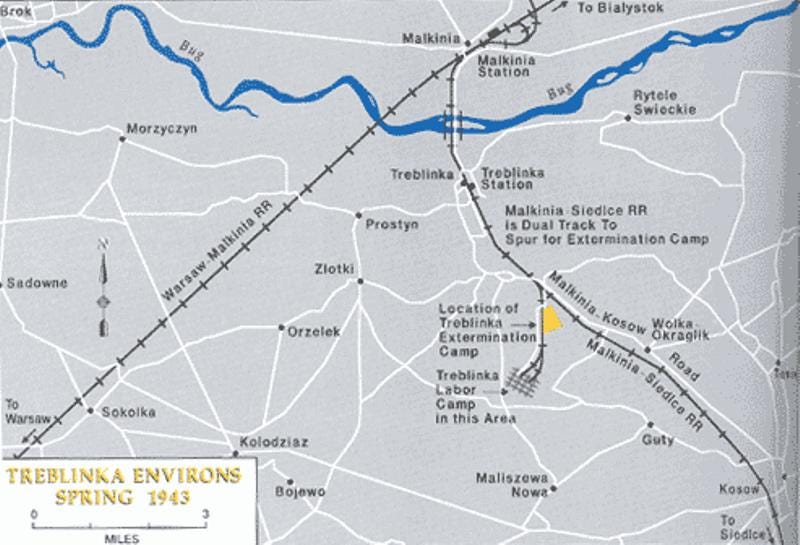
Built eighty kilometers northeast of Warsaw in the summer of 1942, it became operational on July 23—one day after the deportations from the Warsaw Ghetto began. This was not coincidence. Treblinka was constructed specifically to murder the Jews of Warsaw.
There were no barracks.
No labor details.
No selections.
No tattooed numbers.
Victims arrived by train, were separated by sex, stripped of their clothing and belongings, and marched down a narrow camouflaged path the Germans called the Schlauch—the “tube.” At the end were gas chambers disguised as showers.
Within hours of stepping off the cattle cars, they were murdered.
In fourteen months, approximately 870,000 people were killed at Treblinka. Fewer than seventy survived.
Then the Nazis dismantled it.
They tore down the buildings.
Plowed the earth.
Planted crops.
Built a farmhouse.
They tried to erase it.
They nearly succeeded.
Treblinka worked so efficiently that it nearly vanished from memory.
Edna’s family—her aunt and uncle, her cousins, others whose names I will never know—were among the Jews transported from Warsaw to Treblinka in the summer of 1942. They boarded the trains at the Umschlagplatz believing the German lie about “resettlement in the East.”
They were dead before Edna turned eight.
And I was fourteen in a movie theater, falling in love with the phrase summer of ’42, not knowing it meant anything other than romance and longing and a beautiful woman on a beach.
That’s what ignorance looks like—mine included.
I’m sixty-eight years old now. I’ve spent years writing Edna’s story, learning what I should have known decades ago.
The summer of ’42 wasn’t just a movie.
It was a machine built to murder nearly a million people—and it worked so well that most of us have never learned its name.
Treblinka.
Say it.
Remember it.
That’s what the summer of ’42 really means.
__


