


Warsaw, 1989: Three generations stand before the Ghetto Uprising monument, on the ground where the ghetto once stood
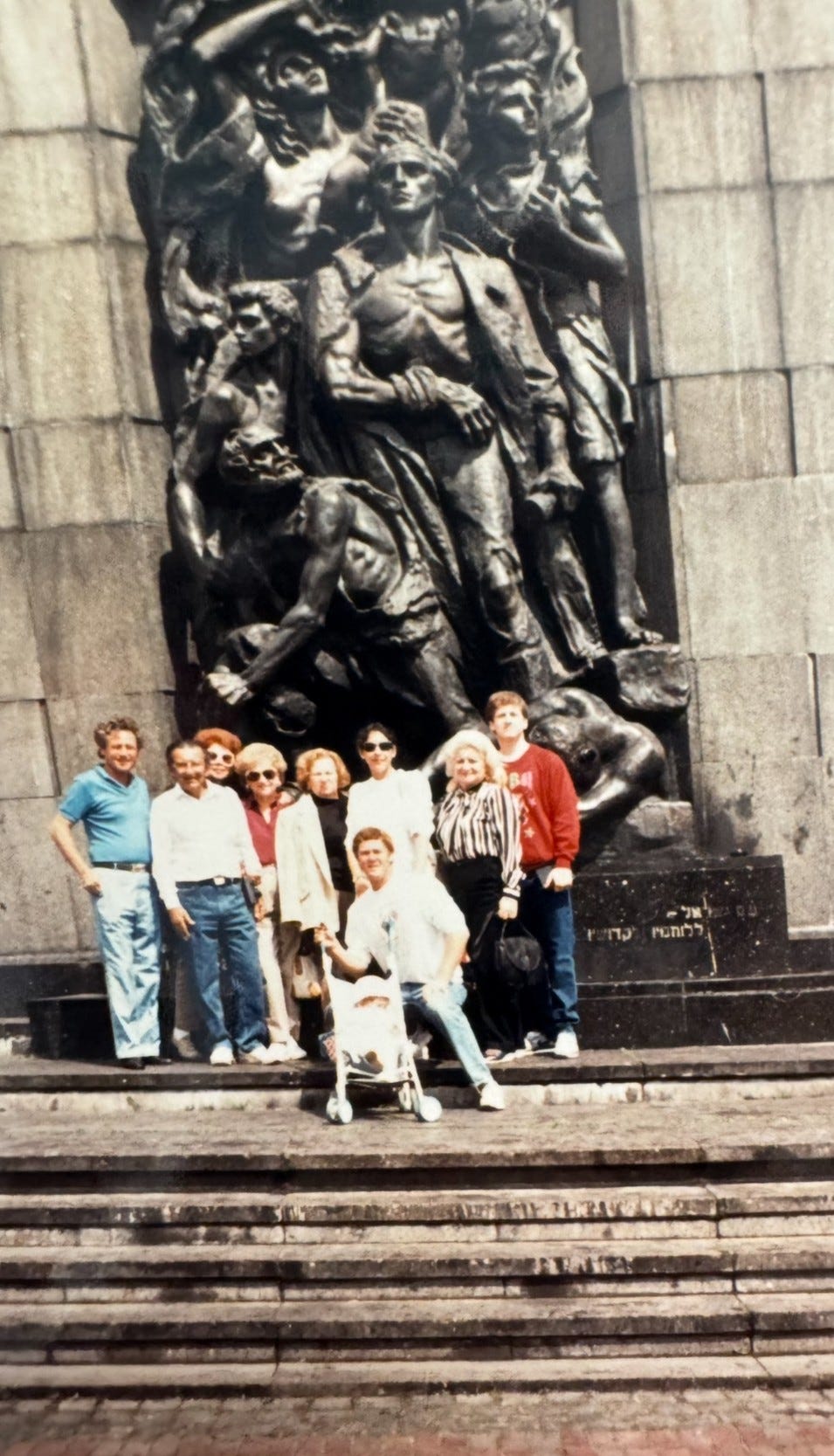
This is what survival looks like.
In the center, rising in bronze, is Nathan Rapoport’s monument to the Warsaw Ghetto Uprising. Mordechai Anielewicz stands at the front, grenade in hand, the fighters massed behind him. The monument was unveiled on April 19, 1948, the fifth anniversary of the uprising, on the ground where the ghetto once stood. The granite came from Sweden — the same stone the Nazis had quarried for a victory monument they never got to build.
Standing on the steps in front of it, in the summer of 1989, is my family.
The Survivors
Next to him is Saul, from Krakow. He survived Mauthausen.
Genya stands beside him — a friend from Brody, one of the few who lived through the war. I do not know the details of how. I know only that she was standing there that day.
Clara is there — Harry’s sister, the only other member of his immediate family to survive. She too lived in the woods throughout the war. After liberation she and Harry found each other in Lvov.
Anja stands next — another friend from Brody, another improbable survivor.
I am there — Janet.
Beside me is Edna.
Edna was born at Mila 18, in the heart of what would become the ghetto. She smuggled food through the walls as a child, survived on false papers on the Aryan side, fought as a courier in the Warsaw Uprising of 1944, and spent the last months of the war in German POW camps. This was the first time she had returned to Warsaw since she left.
Next to her is Eli, Edna’s son.
Crouching in front of me is Sam, her other son, and with him, in her stroller, is Rachel — the first grandchild.
She was born into a world the Nazis tried to make impossible.
The monument commemorates the fighters.
The photograph is the answer.
I do not remember what anyone said that day. I think no one said much at all.
What is there to say?
The bronze figures rise behind you, frozen in their moment of defiance. The Hebrew inscription cut into stone. The steps beneath your feet where ghetto streets once ran.
And you are alive.
Your children are alive.
Your grandchild is in a stroller.
The people who tried to murder you are dead.
You are still here.
I think about what it took for each of them to stand on those steps. The decisions made in seconds that meant life instead of death. The forests. The camps. The forged papers. The hiding places. The ships turned back. The borders crossed.
Edna’s war was not Harry’s war.
Harry’s war was not Saul’s war.
Different cities. Different countries. Different circles of hell.
And yet here they are, together, in the one place that belongs to all of them — the place where the Jews of Warsaw rose up and fought, knowing they would die, so that the world would know they had not gone quietly.
They were there.
That was enough.
Rachel is in her thirties now.
Most of the survivors in the photograph are gone. Edna died in 2019. Harry in 2020. Clara and Anja are dead. Genya — I do not know. Saul is still alive. He is one hundred years old.
Eli, who stood there that day beside his brother, is gone too.
But the photograph remains.
And the generations that followed — Sam, Edna’s son, and Rachel, her granddaughter — carry what they saw. They stood on the steps of the Warsaw Ghetto Uprising Memorial — a son beside his mother, and a granddaughter before them all.
They will remember.
That is what the photograph is for. Not only to commemorate the dead, though it does that too. But to prove that the dead did not win. To show that survivors returned with their children and their grandchildren and stood in the place where they were meant to be erased — and said nothing, because nothing needed to be said.
They were there.
That was enough.
Janet Bond Brill, PhD, is the author of Little Edna’s War, based on her mother-in-law’s Holocaust testimony, published on January 27, 2026, on International Holocaust Remembrance Day.


